After a long travel day across all forms of transport, we arrived in Amsterdam and after a quick overnight in a nearby hotel we met up with Mr. Wander’s family. They landed that morning from Minnesota and we were to catch our next flight together to Arusha, Tanzania. After a delayed flight we arrived late in the evening and met with our drivers from the safari company. It was a long bumpy ride to our accommodation but they served us dinner despite it being after their normal serving time. We settled in for the evening to get ready for tomorrow’s adventure: a 4 day safari through three different national parks, Tarangire, Ngorongoro, and Serengeti.

Day 1: Tarangire National Park

The next morning we were up and ready to meet our driver, Calvin after a nice breakfast buffet at the hotel. We got acquainted with our new ride for the next several days, a 4×4 Land Rover Safari vehicle with a top that would pop up when we were in the parks and adjacent to wildlife.

One of the first trees I noticed as we were driving through the town were these gorgeous Jacarana trees with purple leaves or flowers! They were so pretty and vibrant.

It was a few hours drive to get to Tarangire, including a stop to pick up our lunch for the day. Along the way we saw several herds of donkeys, goats, and sheep being herded to find grass or carrying water for Masaai tribes.

Tarangire means River of Warthogs in Maasai, and covers about 2700km2 of land. Just after the gate, we were gifted with a few beautiful Baobab trees, this one is over 300 years old!

Soon we found our a group of Savannah baboons, some sitting up in trees including one of the larger males, and several picking insects off each other on the ground and others, well continuing their species. Not far down the road we saw our first species of Antelope, a herd of male Impalas.


A few mongoose decided to take the opportunity to cross the road in front of our stopped vehicle and we got a few pictures of them scurrying and watching for predators as they made their way through the bush.

There were several termite mounds we drove past, this was the most interesting. Termites come out at night, they have both a King and Queen for about 1-2 million in just a smaller mound about half this size.

Calvin introduced the next tree by pointing out the “African Sausage” dangling. The actual name is Kigelia Africana. Baboons are the only animals that take advantage of the tasty sausage shaped fruit.

Soon we caught up to a few other tours who had stopped near a watering hole where a herd of Savannah Elephants were playing in the water. Forest elephants are the other type found in Africa but we never saw them. There were a couple of baby elephants, the youngest about 5 months old! We spent a few minutes watching them before moving around to get a different view. A few wildebeests were hanging out nearby as well.


Eventually a bull elephant came close and actually started harassing one of the young babies, but suddenly we saw all the females herd the young ones together and surrounded them to protect from the bull, and they trumpeted and forced the bull to walk away. Then they crossed the road where we were parked.

One thing I didn’t like was that as the elephants were crossing, so many of the other trucks were coming up close to these elephants trying to cross. Some did not seem very respectful to other cars already there, or even worse, to the animals.

This was one of the reasons I really appreciated our driver, he was usually pretty calm, he got us the best view possible, but was considerate for other vehicles and especially gave animals space and let animals come to us if they wanted, rather than the other way around.

As we continued we found a herd of Eland, which is the largest species of antelope. There were a few birds that Mr. Wander snapped pictures of but I did not catch the names of these in my notes. If you know what they are please comment below!


Before we left Minnesota, a friend tasked us with learning whether zebras are white with black stripes or black with white stripes. What do you think? Here we found a few zebras with their young.


Calvin confirmed that they are actually white with black stripes (or brown for the young)! Furthermore, the stripes are actually like a fingerprint for humans, or a tail print on a whale, they are unique to the individual zebra!

For lunch we had a very delicious rice that was made with cinnamon, cardamom and some carrots, along with both fish and veggie curries with some potatoes. It was a surprise every day what we’d get for lunch as each of our accommodations would clean up the dishes and fill containers with new food for the day. It was a surprise for Calvin too!

I tried one of the local beers at lunch, a Kilimanjaro lager. The locals told us that for those that don’t climb Kili, they drink it instead! Since we postponed the Kili climb, we will settle for the lager, for now.


The lunch spot had a cool overlook of a river where we could see elephants down below, but we also had to make sure to protect our food from little thieves: several very persistent monkeys! A monkey managed to steal a banana right after they opened their lunch box at the table next to us. Their guide said the monkeys can tell the difference between guides and tourists and generally would wait to steal food when the guides were distracted.

We headed down the hill and crossed the river to see some of the elephants we had seen from above, as well as getting our first sighting of the animal Mr. Wander’s mom was most hoping to see: a Giraffe!

We found more antelope, baboons, and very far away we caught a glimpse of several cape buffalo but it was too difficult to get a good picture through the trees. The last new animal of the day was a southern ground hornbill pictured by the water.


An elephant let us get up close and personal as he was eating off a tree right next to the road. Calvin let us know that they have found elephants to be right or left “handed”. You can tell by looking at their tusks, usually whichever side they favor will be shorter from more use in trying to bend over trees to get at succulent leaves that are out of reach. Throughout the park we had seen signs of trees broken over where an elephant had knocked down the trees.


Our guide also pointed out that the ears of an elephant it looks a bit familiar: It’s a map of Africa! A male elephant this size can be up 5000 pounds and needs to eat 800 pounds of foliage per day! Males leave the family group when he gets older, and can grow to be about 13,000 pounds – on average.

It was finally time to leave the park and headed towards our accommodation. It was more than an hour drive so he did stop at Safariland for a bathroom and an opportunity to learn about Tanzanite mining and Ebony carvings. We all somehow managed to skip the tour but it was mostly a sales pitch anyway and we were all pretty tired.


That evening we were welcomed by our accommodation with a song and some jumping demonstration by some from a Maasai tribe. The song was mostly in Swahili but I did hear some “hakuna matata” which means “no worries” in English. For anyone who didn’t know that you might need to watch The Lion King again!


For dinner it was a buffet, and we all enjoyed the soup greatly. This was a staple at each of the locations but for most of us this was the first time trying it. It’s a sweet root soup, made from sweet potatoes, pumpkins, and other vegetables with delicious spices. It became one of my favorite Tanzanian dishes all trip!
Day 2: Serengeti National Park

After a lovely night’s sleep we enjoyed breakfast, packed our bags and were loaded into the vehicle by 8:30am. They sang a goodbye song for us this morning, which I caught a little of on camera as we pulled away.
Today we were headed through Ngorongoro. We climbed through several switchbacks up to the top and stopped at the overlook to see down into the caldera. There was a rhino walking by the darker grass and Mr. Wander tried to get a picture, but it was quite far away.

We were coming back through Ngorongoro for a more detailed exploration in a few days so we soon were on our way. It was a pretty drive coming down from the higher elevation, where we could see several Masaai villages and some herding various animals to find feed and water throughout the day.

After this we had quite a drive on a bumpy dirt highway until we reached a few buildings that we could stop for a bathroom break and stretch our legs.

The last bit was very rough as they were working on the highway and so various tracks went off into the brush or we met up with other vehicles, as it wasn’t clear which way you were supposed to go when it went down to one lane.

Finally we made it to the Serengeti gate where we stopped to eat our lunch. We found a large table in the shade of a tree that was able to fit all of us. This time there weren’t so many monkeys, but there were birds that came close to the table a few times.

After we packed up our lunch and he got us checked in, we entered the gate and he veered off from the main road pretty early to explore the eastern part of the park. Right away we were blessed with a male lion hanging out near a bush. He didn’t move around too much and eventually walked to the far side and laid down lower than the grass so we couldn’t see him.

Up in a tree we spotted a vulture. As we approached she flew away from the next, I’m sure to draw our attention from her young up in the tree.

Not far away were a few antelope that we tended to see together, Grants Gazelle and Thompsons Gazelle, the Thompson being characterized by the black stripe.

We headed up towards a rock formation and under a few of the trees were a pile of lions sleeping through the hottest part of the day. When none of the vehicles were moving and people were quiet, you could even hear them breathe or possibly snore a bit as they were sleeping. So crazy how close they were, and those that were awake really didn’t care!


Our guide didn’t have the radio on the entire time, but a few times he turned it on maybe if he saw someone looking at something. After asking on the radio, and as the other vehicle left the area, we headed over to take some quick photos. Mr. Wander’s nephew was most excited as this was his favorite animal: Cheetahs! There were just two here, but usually they create a coalition of males and can cover territory up to 5km2.


We left pretty quickly both to leave the cheetahs room and because we weren’t supposed to be off the road too far. However, every car seemed to be heading to that location, so I’m glad we got there when we did.

Riding along, Mr. Wander spotted a small cat in the grass that looked somewhat like a small cheetah, a Serval cat. It was a young one but still would not grow much bigger.

Our next antelope we came across is called a Hartebeest. We often referred to it as a cow-deer, as its long face looks a bit bovine, but it’s named hartebeest since the horns make a heart shape.


Another pride of lions were piled under a few trees nearby, but this time there were several cubs, and a few males. One cub seemed to be lying a bit apart from the rest, and he looked pretty skinny, making us all think he was likely sick.

I had been increasingly impressed by our guide’s ability to find animals but I honestly don’t know who could have spotted this next animal first, unless it’s a popular resting spot for our next of the big cats: Leopard. By the time we got there, several other cars were already vying for a spot to get a good picture. We ended up crossing the ravine the tree was in to get a view from the other side, but a few of the cars were less considerate and liked just parking there for long periods.

The leopard seemed unbothered, likely taking a snooze in the heat of the day but we saw its tail move a little and sometimes moved a leg, but he was very difficult to get a picture through the trees. I’m always impressed by Mr. Wander’s photography skills but this was so hard to even see and we were almost as close as those lions in the last picture.

Yet another antelope species called a Topi greeted us as we began our drive to our accommodation: a tented camp deep in the central Serengeti. We saw several Giraffes, one even decided to cross the road. Fun fact: a giraffe’s tongue is 45 cm long!


We saw some baboons and even a few hippos as we crossed a bridge but they stayed mostly submerged, looking like smooth rocks, but with ears.

Finally we reached our camp, where they greeted us again with a song, and we were introduced to our host. After a short introduction and safety briefing, we headed to our tents. These were very nice tents, putting the “glam” in “glamping”. The entire tent was suspended on platforms about 2-3 feet off the ground. It included a large bedroom with a king sized bed, and a fully plumbed bathroom with two separate showers, one inside and one outside, with one wall fully open to the elements but away from any paths so you could shower with nature.


We had to call for an escort with our host, Manyama, to get back to the main lodge as dinner started after sunset. We grabbed a drink, our first taste of Serengeti beer. What better place than in the Serengeti to try it? While it is the same kind of soup, the recipe used here was my favorite out of any of the places, with such warm spices and delicious vegetables.

Day 3: Serengeti NP and Maasai Visit

This morning our host set us up with our breakfast table out on the serengeti, with a beautiful view like we were right in nature.

We learned from one of the security that he saw a lion walking through his area of camp at about 4am! We had only heard some whooping from small animals running under the tent but Mr. Wander’s brother had heard a lion before they had fell asleep!

Soon it was time to load back in our truck and continue on our journey. Just a minute or two after leaving the camp we came up on a pile of vultures going after a carcass, it was a mix of Lappet faced and Rüppells Griffon Vultures. There was a small jackal investigating the area but he was no match for the vultures and decided to move on. We figured this kill happened sometime in the night as it wasn’t there when we arrived to the camp the previous evening.


We came upon a group of zebras and wildebeests in a row heading to cross the road. The zebras were mostly in front, and Calvin told us they have a symbiotic relationship. Wildebeests are able to smell water, and can help lead zebras during dry seasons to find water. Zebras have a much better memory, so when they need to get back to certain regions or areas they will lead the wildebeests. From the side it only looked 1-2 wide, but when we came even with it just as the first several were starting to cross, it was 5-6 wide. A tiny taste of what the great migration could look like! To see it at this time of year, near the end of September, you need to be farther north in the Serengeti or in Kenya.


A few pumbas appeared, and we couldn’t help singing the hula song from the Lion King movie whenever we saw them! We also met our first secretary bird. They travel in pairs and feed on small snakes.


A different antelope called waterbuck decided to greet us this morning, along with a cape buffalo peaking over a dirt mound.


We had to stop for gas at probably the only station in the entire park, but it was a good opportunity to use the bathroom. I found this sign entertaining, while meanwhile Mr. Wander found a Marabou stork in a nearby tree.


Next we came to a larger watering hole full of hippos! There was an alpha male on land that was looking out for the rest but most of the group stayed in the water to keep cool. Hippos tend to graze grass at night when it’s cooler and mostly just sit in the water throughout the day.

They were mostly still, but every once in awhile someone in the group decided they wanted a different spot and it seemed like they would try and pick a little fight, with a bunch of grunting and open jaws, and then they’d settle down again. Hippos also often relieve themselves in the water, sticking their tail up out of the water, and spin it quickly to ensure they fling it everywhere. Needless to say you could smell the hippos before you could see them.


We came up on our first Elephants in the serengeti, with a Matriarch that was likely 50 years old, in a group with the smallest baby that was maybe a month, so cute!


The smallest antelope, called a Dik-dik, that looked smaller than many babies of the other antelopes, but this was a full grown adult!

We saw a few more antelopes, including a Thompson gazelle, and a bird called Kori Bustard. It’s the heaviest flying bird in Tanzania! We found another pile of lions with their cubs already napping as the day grew warmer.


Soon we were back at the gate and we had lunch here once again before heading back on the bumpy highway to Ngorongoro crater. We did stop part way to a Maasai village, where we learned a bit about their way of life and strange diet: they only eat meat!

They tend herds of goats, sheep, and cows, but are most known for their jumping abilities. First they had us dress in some traditional dress, performed a welcome dance and song for us, and then showed off their jumping skills in a contest, where both women and men were jumping. It’s amazing they don’t necessarily crouch super slow but seem to rebound from their first jump and get even higher on the second or third.

After they brought us into the school where the young kids counted and recited the alphabet in english, and sang a song for us. It was a simple structure made of sticks but was remarkably cool since the wind could blow through and was well shaded.

Next they let us go into a home with a member of the tribe that spoke english so we could ask questions and take pictures. The walls are mostly cow dung and grass, built up thick and slightly into the ground to keep cooler. The roof was full of grasses and had a smoke hole for when they cooked inside. I did not realize they were polygamous, but in my understanding the first wife had to approve of any subsequent wives. The men were the ones that went out to collect materials and brought them back, but the wife built the home. For a man with several wives, each wife had their own home and he would stay in a different one each night.

At the end they brought us past their crafting area. I was looking at the bracelets at first but most were too small to fit my wrists! The unfortunate thing was that they wouldn’t give you the price until after you picked things out and were separated from other members of your group. This tactic reminded me of timeshare presentations and kinda made the whole experience feel a bit less authentic.


It was time to make our way to our accommodation for the evening, which was right next to one of the entrances into the crater. First we had to climb back up past that observation point from the day before and then off a gravel road until we reached our camp. While this was less fancy, it was still glamping as far as tenting goes. They had a campfire and we enjoyed some wine and watched the sunset, chatting with some of the others staying at the camp until dinner. When we got back to our beds, we found hot water bottles warming up our beds. As we were fairly high in elevation it does get pretty cool at night. Mr. Wander and I did ask for hot water to shower, so they boiled it and poured it into a tank above our bathroom so we could have some warm water to wash off the day’s dust.
Day 4: Ngorongoro Crater

The next morning we were able to head down into the caldera bright and early. A baboon was walking along the road before we had even started descending! Not long after we really got our fill of Cape Buffalos, there were so many groups!


As we came down along this ridge there were a few vehicles stopped, and our guide said there wer elions. It took us awhile to see it, especially me, but they were laying down and were quite hidden in the grass.

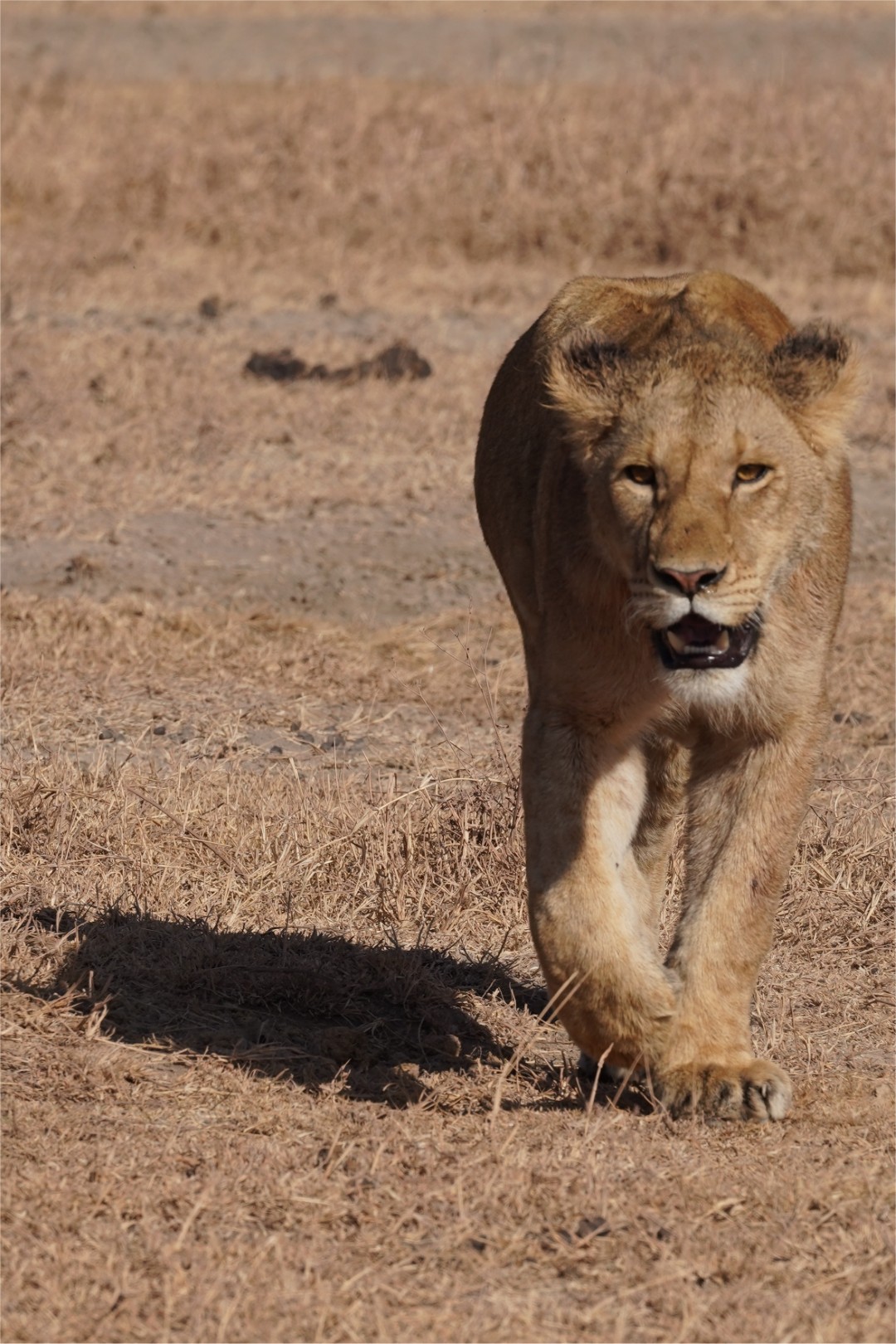
Not long after, we saw another lioness escorting two cubs but she didn’t seem to mind having us nearby. The cubs got nervous after the lioness crossed the road between the vehicles, so they stopped and meowed a bit before finally crossing and continuing on their way. The meows were so cute!


A bit farther we saw a few males sitting in the grass. Doesn’t he look so magestic in the morning light?

Up in a tree we spotted a black crested snake-eagle, which must have been searching for its next slithering snack.

One of my favorite moments was watching this zebra scratch himself on a rock! Who knew even zebras need a good belly rub once in awhile!

We caught sight of a few ostriches nearby. The male is the black one and the brown is female. They often just stick together in pairs rather than larger family groups.


I was a little nervous for this next sighting, a hyena, that was walking right towards us! He got close enough I decided to roll up my window farther, just in case. He eventually meandered off to the side before crossing the road behind us.


By a marshy green area we found a few waterbucks, a grey crowned crane, and a grey heron! A few hippos were hanging out in the water as well. We even caught an Ibis, a few ostrich, and a Kori bustard.


As we headed closer to the bigger lake, we saw a two lionesses walking across an open area where plenty of antelope were grazing on the outer edges. One smaller antelope decided to cross the plain in the other direction, but it was like watching a standoff, because both lionesses and the little antelope would stop and stare, waiting for the next move. After several minutes of this, they had both crossed and the lionesses headed more our way and crossed between some of the cars. The antelope must not have looked like a big enough meal.


As we got to the lake we saw both the Lesser Flamingo, the pink ones, and the Greater Flamingo, which was all white.


It was time to head into the forested area, and there was a backup of cars looking at something in the brush, set back into the trees. Calvin found out from other guides that it was a Rhino, and Mr. Wander thought he caught a glimpse of a black horn. He was likely taking a bit of a nap. Rhino is one of the harder animals to find of the big 5, there is only 20 in the entire caldera!

On the road out, we were noticing paths in the woods and then suddenly, out of one of the paths an elephant popped out! A smaller elephant followed this one, crossed the road, and headed down what looked like a steep path between the switchbacks we were driving up. Very brave elephants!


The entire caldera is 100km2, and is at about 5700ft of elevation, but to head out we needed to climb about 2000ft to get back up to the observation point, but we caught a few views on the way up. We did stop once again to get last view of the caldera, and we managed to catch a rhino again, in the same spot close to the forested section.

We drove for a bit before stopping to eat lunch at an area full of different paintings and art depicting our favorite animals. Several hours later we made it back to Arusha to the same hotel where we started our Tanzania journey. This time we came while it was still light and were able to enjoy some time by the pool with some cocktails.

At the pool I ended up meeting someone that lives in my hometown! Now this is pretty crazy since my town might barely reach 1000 people! His brother in law is one of my favorite teachers growing up, so we knew a few of the same people. What a small world!
Next Time
After just a few hours of sleep we were whisked off to the airport to catch our flight to Istanbul. Instead of having a layover, we decided to make it a stopover for the family to experience a bit of Türkiye before continuing onto our second African adventure.
As I didn’t get as much done while in Europe, we’re now in southern Africa and finding very limited Wi-Fi and even more limited free time. I’m hoping to get the next few finished soon. Hakuna Matata (no worries), I’m keeping copious notes so I don’t forget all the cool places, animals, people, and delicious dishes we find along the way! Until next time, kwa heri!

Leave a Reply