After 4 days of hiking, we get a full morning exploring Machu Picchu, and getting an appreciation for the depth of our guide’s knowledge. We get back late only to have another early morning wake-up call to visit one of the rainbow mountains. Finally we treat ourselves to sleeping in and a few dips in an amazing hot tub with the most gorgeous view of the stars! We told ourselves it was going to be relaxing but it was mixed in with a bit of adventure.

Machu Picchu
This morning we got up early to pack our bags, eat breakfast at the hotel, check out, and make our way over to the bus pickup. There weren’t any lines here but we did have to wait a minute for a bus to arrive. Once we boarded and started moving, we managed to catch a few of the spots where the “hiking” trail crossed the road for those who walked fully into Machu Picchu instead of taking the bus. It’s not so much of a hike as it is entirely steps ascending 1280 feet, with the only flat portions as you cross the road that switch backs up the mountain. A few of the group opted to take this early trek, leaving at about 4:30am to climb all the way up to the top.

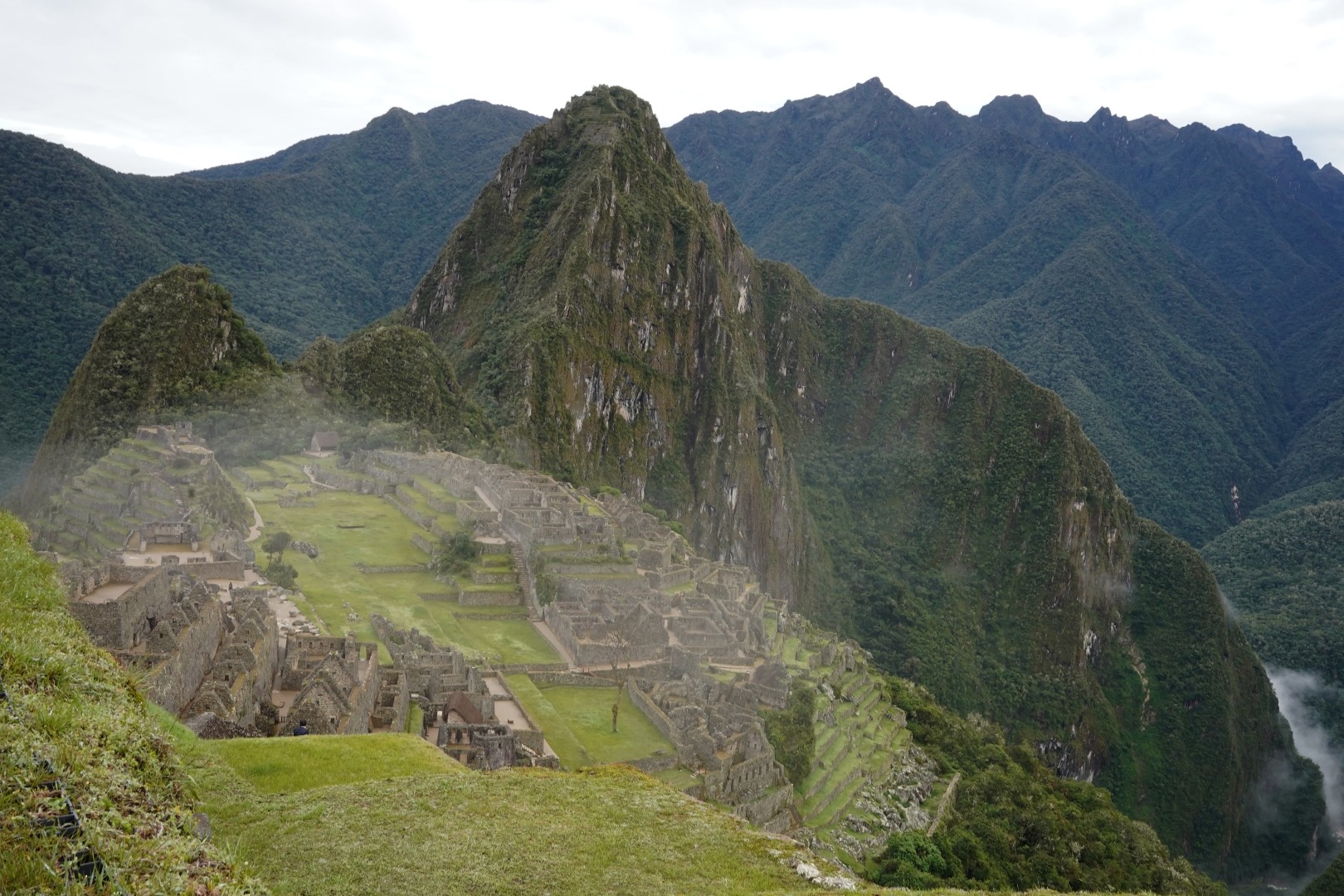
We made it up and got in line to enter with our guide. There are three circuits once you get inside, Circuit 1 just takes you up to the viewpoints to see Machu Picchu from the top. Circuit 3 allows you to walk through the city and feel like you are a part of history. Our tickets were for Circuit 2, that allows for the best of both where we got the first overlook and then walked into the city. We had stairs of our own to climb up to get to the first viewpoint, where we met up with those that hiked up this morning!


What a view!! We really lucked out. Not only was it not too busy when we got here but the clouds stayed away enough to get some good pictures. It wasn’t just the tourists enjoying the view though, a few llamas decided to join us! The mountain top behind the llamas is what the city ruins have now been named after, Machu Picchu, since we don’t know the original name for the city.

The mountain behind the city is called Huayna Picchu. Some people climb to the top of either Machu or Huayna Picchu mountains, but Huayna has more accidents. There are ruins on Huayna Picchu as well but it was currently under renovation to add a different entrance into the city, connecting to another Inca trail.

The most popular route into the city is the traditional Inca Trail, where you hike at night and try to reach the sun gate at sunrise. This gate was built to align with the sun during both the summer solstice. The positions of the sun and moon were very important to Incas, they have several points within the city that reflect this as well, such as the temple of the moon that radiates moonlight at night, and the sun temple to shine brightest on the summer solstice.

We started to descend into the city, our guide giving so much background and history. From the intelligent planning with layers of rocks of decreasing size just under the foundation that ensured there was minimal erosion, despite all the rainy seasons of the last 400 years! The city has been reconstructed in spots but only about 30% has been restored, the rest is as it was found in 1911.

Most of the walls are made of large stones with trapezoidal shapes to help maintain structural integrity even with earthquakes that occur in this region. In spots where they used mortar they used a specific clay found only in the sacred valley which is quite a distance to transport 400 years ago, mixed with sand and water. It’s amazing just how well this place has survived given numerous earthquakes and rainy seasons!

The purpose for this city is not completely known. There have been many guesses but just last year new ruins had been found in the Amazon jungle about 50 kilometers away. It was thought previously this was the farthest north boundary of the Inca Empire but now that we know it stretched farther north, Machu Picchu could have been a conduit for connecting different areas of the kingdom for trade or messages. It is still thought to be a religious temple but also was a strategic location to expand into the Amazon.

When Machu Picchu was discovered in 1911, there had already been rumors of something in this area of the jungle. Eventually graffiti was found from a local in 1902, likely where the rumors had originated. Some of the Inca roads leading here had been destroyed which is why it was harder to find. It is thought Incas did this before they left to prevent Spaniards from finding it when they had arrived in the region.

It was covered in vegetation when found, and they decided to use fire to eliminate the green without damaging the stone from more manual methods. The unfortunate consequence was it also burnt all the remnants of the buildings roofs or timbers placed into the stone to support upper floors within the homes and other buildings. A few have been reconstructed for show to give an idea how they might have looked when the city was populated. In 1983 it was named a UNESCO world heritage site but per that rule it must be left as found, but what had already been reconstructed was kept.

One of my favorite spots in the city was the terraced greenhouse area. It was one of the warmest areas of the city with different levels. The Incas were known for their farming practices and here they would rotate crops up the levels to get the crops to acclimatize to elevation after several growing seasons.

A unique feature that is difficult to see unless you climb to the top of Huayna Picchu, is that the entire city from that angle looks like a Condor! Other major cities found in the Inca empire were also built to resemble various animals, and for each animal they tended to have a different meaning. Condors were thought to be messengers of the heavens, the Puma was the symbol of life on earth, and Cusco, the old Inca capital, was designed in this shape. Lastly the snake represents the underworld, but for Incas it wasn’t a place of punishment, it was for beginnings and new life.

Our guide took us to a few of the temples, it is easy to determine from the houses or other buildings as each block were perfectly smoothed and shaped with flat sides and sharp corners, fitting perfectly together. There is evidence of temples not being completed or older constructions found to be buried by new buildings, indicating a city in change and constant improvement before it was abandoned.


One area was a full religious square, surrounded by various temples and a nearby observatory. Observations of star constellations were used to predict el niño years as agriculture was important to the economy of the empire. A little farther away we visited the temple of the condor, which was really unique, using some natural stone as part of the architecture of the building.
Back to Cusco
Before we knew it, it was time to leave. We got our last look at the city before we exited to the buses that took us down. We were hungry and so we found a snack and some drinks before walking around on our own. Our group got lunch at a place called Machu Pisco, and we had to try their Pisco Sour since they claimed to be the best in town! Not sure it was the best I have had but pretty up there, and definitely the coolest view. Look at this raging river!


After lunch we retrieved our bags from the hotel and headed to the train station. We had a little over an hour on the train, arriving at Ollantaytambo where we met up with a van to pick up our bags and drop us off at our hotel. We said farewell to each member of our group as we were dropped off and then to our guide. It was already pretty late so we just ate some leftover snacks for dinner and got to bed, because we had another adventure starting early the next morning!
Rainbow Mountain – Palcoyo
It’s a good thing we were already used to getting up before the sun because we had another 4:30am pickup time. The nice thing was we had a few hours in the van so I got a few extra minutes of shuteye, but first we stopped for breakfast about 45 minutes outside the city. It was a pretty expansive buffet with so many options and several other tour groups also heading towards one of the Rainbow Mountains.

The most popular option is closer to the city but it can be very busy with tourists. We opted for an alternative one even though it was a bit outside the city so it would be more relaxing without the crowds. So we hopped back in the car and after another hour or so we started heading up a gravel road. Near a gate managed by the community for access to this particular mountain, we met up with a group of llamas that were a bit confused as to why we were driving on “their” road.

It was a bit wet on the way up and by the time we made it to the top, which was at about 16,000ft, that rain had turned into snow. We carefully made our way up the steps to the start of the trail. I could tell the community that manages this area had put so much work into the paths, creating steps, outlooks with benches and a wall, and bridges over some of the streams that would cross the trail.

We got to the first lookout which gave us the first indication that today’s rainbow mountain would look more like white mountains thanks to the snow. We could see a few of the stripes on the closer mountains but mostly they were white. These stripes are usually red, green, and orange thanks to the Iron, Magnesium, and Sodium minerals in the rocks.


There was about a 1 mile out and back trail that took us to a few viewpoints that while not colorful, was extremely peaceful since we had it to ourselves, and were the first ones to take steps in the fresh snow. We opted not to take the steeper route through a rock forest because of the snow did make it slick in spots and as I had already taken a few falls just in the rain, it didn’t bode well for me not to fall on the slushy snow, so we made our way back the way we came. I just about fell twice so that was a good call!

Back in the car we made it down the mountain and he took us to visit these three bridges in a nearby town that were made in different eras. An Inca bridge, a Spanish bridge with cool designs in the stones, and a colonial bridge. the Inca bridge seemed a little sketchy made from vines and sticks but we could see some steel reinforcement. While definitely not authentic, I was quite thankful.


Then it was time to go back to the same restaurant for a lunch buffet. It was not too bad but we were both ready to get back to the room for some relaxing!
Starlodge over Sacred Valley
We finally were able to sleep in and enjoy the delicious breakfast at the hotel. They even had crepes and delicious fruit available. Back in our room we had to repack a bit to just have what we needed in our day packs for a single night, and the rest in our large packs we would store at the hotel. Soon a van picked us up for what is best described as an Adventure Hotel!

We got to stay in a pod hanging off the cliff in the Sacred Valley, called Starlodge! The pods are accessed by Via Ferrata, which involves a series of steps (or sometimes rebar formed into loops) secured into the rock, and a cable you clip into with carabiners connected to your harness.

The company has two different sets of pods, the Starlodge where we stayed, and the Skylodge, which is a mile or so down the road and quite a bit higher up the cliff. For our pod we climbed 285ft from where the van dropped us off, but those in Skylodge have to climb 1300ft! They actually get fed dinner and breakfast at a separate dining pod at the top of the cliff and don’t come back down until the morning, mostly via several ziplines. We, however, had fully plumbed bathrooms in our pods with access to hot tubs near the bottom of the via Ferrata, which 100% contributed to our decision.


When they picked us up, they informed us that we were the only ones staying at Starlodge, but we shared the van with others staying at the higher Skylodge. Once the other group was dropped off, we arrived at the Starlodge. We were setup with our safety equipment: Harness with two carabiners, a helmet with a light, and gloves. Our guide showed us up to our lodge which was the one at the top. We chose this one because we wanted extra privacy, some of the bathrooms were fairly close to the trail and had assumed it would be full of other people. It took us about 30 minutes to get to our pod.


It has room for 4 to sleep but we got the pod to ourselves, whether or not they were full of other people. We took a little time to relax while the guide headed down and then we decided to watch some of the sunset from the little deck on top of our pod.

To sit up there we did have to get our gear back on and let him know, but then we headed down for dinner. There was a tent near where the van dropped us off which is where we got our dinner that consisted of several courses and quite delicious. Then while finishing up dessert, our guide went up to check the temperature in the hot tubs.


We walked up to the tubs in the dark and changed in our own little shower room. He showed us the things we needed to know and then we had the tub to ourselves, enjoying the stars and lights from the valley below. It was so quiet and peaceful!


The water was so warm and relaxing but between the hot water and the wine we were both starting to get tired, and decided to head up to our pod and get to sleep. After getting upstairs we took another photo of the stars, using the deck to our advantage for a long exposure shot. So cool!

The next morning we had opted for a photo shoot with drone videos so we got some cool shots of us and the surrounding area. Most of the shots we are showing in this part of the post (except for the food and stars) are from this photo shoot. Felt like we were doing engagement photos for a bit, but it is nice to have some of these unique perspective photos we wouldn’t have been able to get ourselves.


We enjoyed one more hot tub that morning before we headed down to breakfast, which again was very delicious. I especially appreciated the yogurt and granola bowl with fruit, so tasty! I must have been extra hungry this morning and never took a picture, so instead I hope you enjoy the video including all the drone shots!
Finally it was time to go, where we went to pick up the other group and got to watch them come down on their last few ziplines. We were dropped off that afternoon and after getting checked in we found a few snacks and then relaxed that evening before yet another early wakeup the following morning!
Next Time
After a few weeks of adventures in Cusco and surrounding areas it was finally time to head to a different region. We take a few tourist buses that have us stop at a few overlooks or Inca ruins as we travel to Puno on Lake Titicaca, Colca Canyon to see Condors, and to Arequipa, the second most populated city in Peru. We take a break from hiking and instead work on our photography and chocolate skills! Until next week, Ciao!


Leave a Reply