From Arequipa we made our way north to Iquitos via a layover in Lima, coming down from about 8-12,000ft of elevation for the first time in a month, between Bolivia and the highlands of Peru. Now we were headed into the jungle to cruise our way along the Amazon River. The cruise began on the part of the river where two rivers came together, and we were on the upstream named Marañón. We had 4 days exploring with a few naturalists, using smaller skips to get into various channels to view plants and wild life and to visit a few villages along the way.

I do want to warn anyone squeamish about spiders or snakes, you might want to scroll cautiously through the pictures on the 2nd and 3rd day of the cruise (Helping the Rainforest, 2 spiders around breakfast and tree planting and just after we see the turtle on the Canoeing section).
A Jungle Cruise
As we were boarding the plane in Lima, we ended up chatting with a couple from Denmark who were getting on the same plane as us. We figured out that they were on the same cruise as we were!


After arriving in Iquitos, we relaxed in our hotel with a few cocktails and some delicious Peruvian dishes. The following morning we met with our cruise naturalists and the rest of the guests in the lobby of our hotel. We boarded a bus and they gave us a box lunch and a short city tour before the few hours’ drive to Nauta where we would board our boat.


When we arrived, they greeted us with a fresh Camu Camu juice and a little intro before boarding skips to La Perla, our home for the next few nights. They served us an additional lunch once we boarded the cruise boat, which I was already full from those snack boxes! We had a little time to relax in our rooms as the boat moved to where we’d stay for the night. After a late afternoon safety briefing, we boarded the skips for a tour that began at dusk to see the animals that come out this time of day.

Our first sighting were the pink dolphins that are common in this part of the river, but they’re a bit more shy than their ocean counterparts and didn’t jump out of the water too much. It wasn’t easy getting a picture of them!


As we moved into the channel, the water was so calm! We had to wait for them to check us into the reserve at this building before continuing farther.

We headed into one of the channels off the main river and the eagle eyes of our naturalist guide picked out this male iguana hiding in the trees! We also caught glimpses of orange wing parrots and several squirrel monkeys running from tree to tree.

These monkeys are exactly what you’d expect, they are nearly as small as a squirrel and jump from tree to tree. They were so quick! The squirrel monkeys are very social and tend to travel with other monkey species, which is why we saw some Capuchin monkeys nearby.

Next we heard the tell tale call of the Horned Screamer, affectionately known as a Donkey Bird. While they are a part of the goose family, they fly like a vulture, sound like a donkey, run like a duck, are according to our guide, taste like chicken, ha!

High in the trees our driver spotted a Hoatzin, which is a very shy bird and it is difficult to get a picture. They are thought to be a prehistoric bird, and this one turned out to be a bit elusive. I missed some of the names but I hope you enjoy these pictures of various others birds Mr. Wander caught on camera and few extra monkey and Horned Screamer Pictures.


Once it got dark they used their high powered flashlights to find different animals in the floating vegetation and next to the trees, attempting to find us a tree frog, one of those that are bright and almost glow in the dark, but we had no such luck. As the skips headed back towards the boat we could watch the stars overhead as we were completely away from any light pollution and it was a clear night.


Back aboard, we all had a little bit of time to clean up, which was nice washing off the bug spray before dinner. It was a buffet but once they realized I was the one with the mushroom allergy they had always made a version of that dish for me separate that was mushroom free, they were so accommodating!


The food was amazing all around, and I loved the cute napkin rings they had, every meal was a different jungle animal and at a few of the villages they made these using local materials like reeds and grasses. I think my favorite was this frog they put in the napkin that was folded like a lily pad. We enjoyed our dinner and shared this and all our meals with the couple from Denmark, becoming fast friends and sharing stories of travels.
Helping the Rainforest
The next morning we were up early to get back into the skips, this time layering on the sunscreen and bug repellent. We had been carrying a 30% deet lotion with us but the boat also had spray so we used both and it was much better at preventing bites, probably because it could prevent bites through my clothes and in my hair much better.


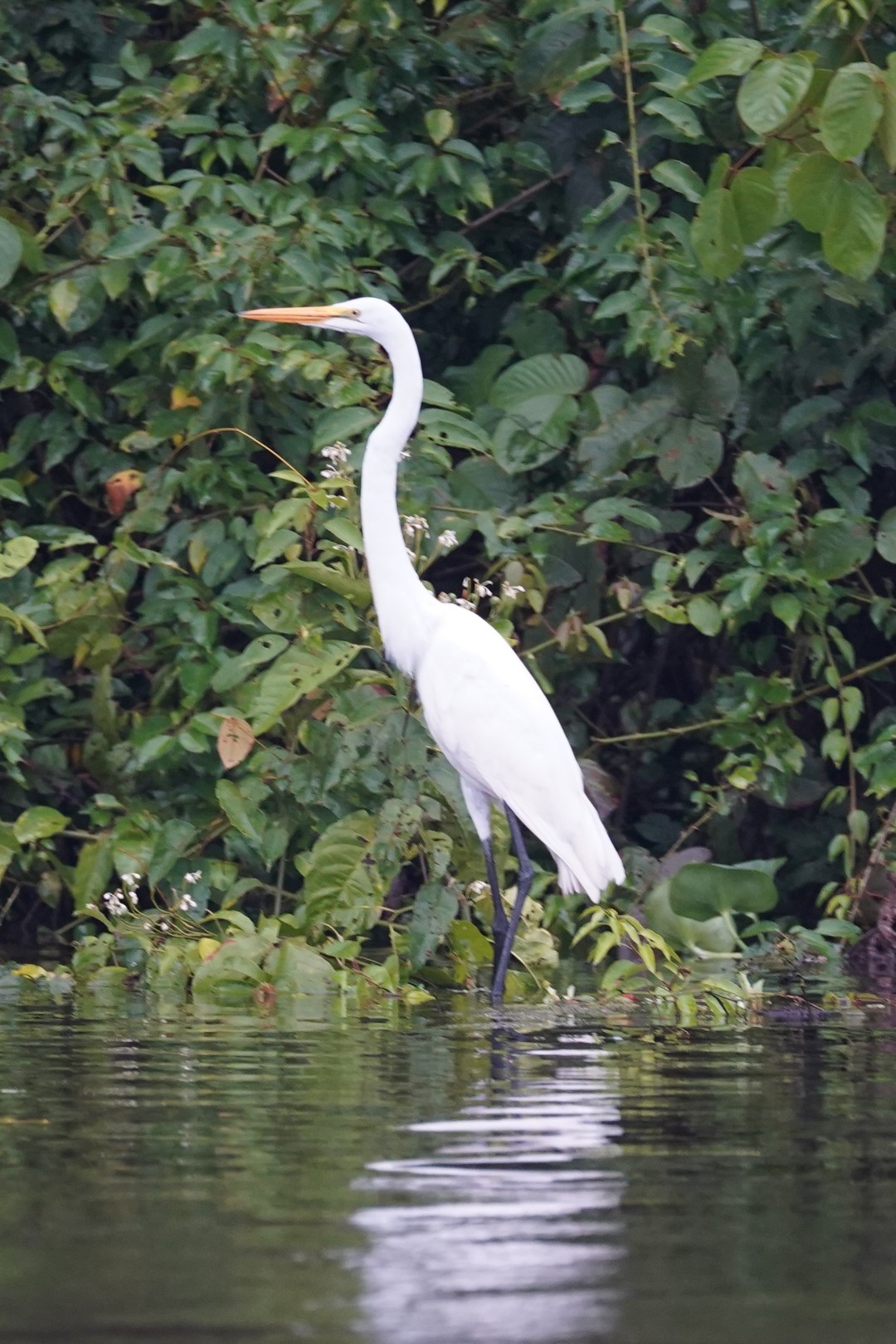
We started off with several birds giving us a bit of a show including the Orange Wing Parrot, an Amazon King Fisher, Yellow Rumped Cacique, a Cocoy Heron, and both the Great White Egrets and the smaller Snowy Egrets. It was amazing how easy our guide and boat driver could pick out these birds, they would try to get us as close as possible so we can try to take some pictures, but many were very high up in the trees. It was a good thing Mr. Wander had his new zoom lens!

Our guide not only pointed out all the birds, but also this yellow flower called Retama that is known for its healing properties such as for the kidney, and its leaves are an antiseptic. He also pointed out a banana tree plantation that was dying due to the exceptionally high water year at the end of rainy season.

We passed a small village of about 90 as kids were singing the national hymn in school. We noticed that homes near the edge were getting very close to the water. Some are built on stilts but even the stilts were no longer high enough as the high water seasons seem to be more extreme.

Next we must have wandered into a Hawk hunting grounds as we found the Great Black Hawk, a Fishing Hawk, and a Black Collar Hawk.


We visited another village where they are working to save the turtle population in the jungle. Turtle eggs are often harvest for eating but the biggest threat are people selling them on the black market. People from this village find turtle nests buried in the sand and bring them back to a protected area they can bury them until they are fully incubated, about 90 days, and they along with La Perla release them into the wild. In this small area they can bury several clutches, each containing about 40 eggs. So far the village has released 7000 baby turtles!

A man village brought a bucket with several baby turtles that were ready for release aboard one of the skips and we all took off to find a spot for breakfast. Along the way we spotted a 3 toed sloth, who we learned has a symbiotic relationship with a moth!

It was amazing what they were able to bring aboard for all of us, including drivers and the villager, to have breakfast. As our spot was wedged into some floating vegetation next to the other boat, we had an unexpected visitor try to join our breakfast. A Pink-toed Terantula! Somehow they seem cuter when given names like that, and the pink toes make it look like they had fuzzy slippers on their legs, but man it was so fast!

As we continued on our journey we had a bit of a shock when we heard a noise and suddenly saw a tree falling into the water! It was lucky we weren’t closer to the edge of the river, and thanks to the quick thinking of the driver we managed to get out of it’s way before it hit the water. Here’s the tree moments after it fell!

Next he pointed out a Kapok Tree, which lives to 200-300 years old and is one of the tallest in the rainforest. They used to make life preservers or nice fabric can be made from the seed pod which is like cotton.

It was sacred in Aztec and Mayan cultures as it was thought if you were buried at its base it would bring you towards heaven. Unfortunately, now it’s known to be excellent for plywood so they have nearly all been cut down in the rainforest except those in the reserve.


As we ventured to our turtle releasing spot we caught sight of a White Throated Toucan flying up in the trees, and a howler monkey! Just as we got into a little quiet pool off this channel we got to see a Spectacled Owl up close. It was probably my favorite experience in the Amazon, I just love owls! He flew away once the other boat got a little too close but wow was that so cool!

We all were handed a baby turtle and released them over the side of the boat into the water. It was exciting to see them swim away, I just hope there weren’t any predators nearby!


There was one last stop for the morning’s excursion to do contribute to the rainforest in another way: plant a tree! At this other village we were given saplings of a type of palm tree that I cannot remember the name for, but we all said a vow to protect the rainforest and then planted it just off the edge of this village.

Along the way back one of the naturalists showed a ruby haired tarantulan again with the cute names. We also managed to catch a glimpse of a tiny dart frog in a tree but it was very shy and difficult to get a picture of it but I did find a small lizard. The village had several cats and ducks that we found on our way back to the skips. A few Macaws and another sloth decided to make an appearance as well!


After a long morning exploring and visiting villages, I was ready to get cleaned up and walk around the boat after so much sitting on the little skips. We were served lunch and then had time to relax for a few hours as the boat moved locations. One of the naturalists gave a talk about the Pacaya Samira National Reserve that we had been exploring, that had begun in the 1940s to preserve the Paiche fish. These fish are massive, can get 10ft long, and are called a dragonfish by the Chinese and considered good luck.

The preserve is so expansive, it is larger than the country of Slovenia, and would take up about half of Costa Rica! It helps protect the animals and vegetation from logging and poaching. However, locals are able to chop trees for their own home repair if they plant 20 saplings of the same type for every 2 cut down.

Before dinner, we loaded into the skips to visit a Shaman at one of the villages. It was fascinating to hear about what she does and how she became so skilled. She was taught by her grandfather, the previous Shaman. It takes 8 years living alone in the forest learning about various plants and herbs and practicing the craft with teachings from the Shaman before you are deemed worthy of the role. Through our naturalist guides, we could ask her any questions and her skills were really impressive.

I was intrigued when she talked about this special drink they use, sometimes to help people unlock memories from their past, or how her Grandfather knew this was her calling at the age of 13. The Naturalist said he had tried it once and it sounds pretty intense, and she can apparently glimpse into the visions you are having! I was really impressed and thoroughly enjoyed the presentation. At the end she gave us all a blessing in her native tongue.
After dinner, they had a special show for us with several crew members playing traditional Peruvian instruments and singing, and a few trying to get people to get up and dance. The bartender would show off his moves as he delivered drinks as well. I was most impressed by the pan flute, this cannot be an easy instrument to learn and his control over the tone and ability to rapidly switch notes was amazing. I have a video below from a song you may recognize, as they played both traditional local songs as well as some classic American songs.
Canoes and Anacondas
After breakfast we loaded into the skips to meet up with several women and their traditional canoes. It was a bit precarious transferring from the skip to the canoe but they sat a bit lower in the water so they didn’t seem to be quite as tippy as the ones I’ve paddled around the Boundary Waters on the Minnesota-Canadian border. Everyone made it into their canoes without incident and we began a tour through tiny channels, through trees.

It was very peaceful, and a bit of a maze. We tried to talk a bit to our boat driver but she didn’t speak any English and my Spanish still needs more work. We were given some oars as well to help propel but even without our help she was one of the faster paddlers.

About 20 minutes in, it began to rain. She asked if we wanted to turn around and we said we didn’t mind the rain, but soon it started to pour and everyone else turned around so we did as well.

The skips came as far in as they could to pick us up and we managed to get back on board. They passed around these pretty high grade ponchos that did well at keeping the rain off. They took us back to the boat where we could change into dry clothes and have some lunch.

In the afternoon we were brought to the shore to begin a hike through the rainforest for about an hour. We split into a few groups based on our walking ability and headed into the jungle. One of the more rare things we saw right away was a Veragated Tinamou sitting in the base of the tree. It was sitting on an egg so it didn’t fly away and we all tried to take our pictures quietly and from distance, but the zoom lens makes it look like we were so close!

We saw several Buttress Trees, which were what the oars were made of to paddle the boats. They were very solid and heavy oars! He found a few vines for us to touch and pull on, think Tarzan type vines! Also he pointed out the rubber tree as you could see some of the sap coming out.

The naturalists worked with a local guide that had been walking off paths into the jungle, armed with a machete and found us a Yellow Footed Tortoise. These are more land based compared to the water dwelling turtles we released the day before. He was really strong and trying to pry my hands off his shell, but I didn’t want to drop him as that would hurt him more. We released him after we all got our picture.


Our guide surprised us with a very rare treat, although neither of our mothers would call it that. He comes out carrying a young Anaconda, which our naturalists estimated to be about 1 year old. It looked already much bigger than most Garter snakes I have seen in Minnesota! The females can get up to 17ft (over 5m) long and weigh up to 175 lb (80kg).

They are a constrictor type so they coil around their prey and literally squeeze to death instead of biting. However, despite what movies might show you, they don’t really hunt humans, but I bet the big ones would defend themselves if provoked. I was surprised this one didn’t even fully try to wrap around the arm of our guide holding him! Most of us took advantage of it being so close and gave him a little pet before he was placed back into the jungle to continue on his way.

Our farthest stop on the hike was to a series of suspension bridges that went from tree to tree. These were a bit more sketchy than ones we took in Singapore, as even the platforms on the tree were limited to the number of people on it at once and they were a little rickety. A few sections were in need of repair so we just did a few segments out and had to turn around and go back. To be honest this suspension bridge made me way more nervous than those pods we slept in back near Cusco!

On our way back our guide found a bullet ant! This also moves fast but that is not why it has the name bullet ant. If you are bit by one of these it hurts like a bullet with intense pain for up to 24 hours along with muscle spasms, and their neurotoxin can cause hallucinations

After we returned from the hike and had time to clean up, we got a short demonstration on how to make a pisco sour from the bartender. Pisco is made from green grapes, and the type Quebranta is specifically used for a Pisco Sour. Starting with ice in a shaker, 3 oz of pisco is added, along with one ounce each of lime and simple syrup. Then you add the white from one egg, add the cover and shake for at least 15 seconds. The citric acid from the lime creates a stable foam like in a meringue. After the liquid is strained into a chilled glass, Angostura bitters is added to the top that helps prevent tasting egg white when you first take a sip. This bitters is used to create patterns on the surface of Pisco Sours, such as those with our names on them back in Puno!

We had one more adventure that evening before sunset, which was to try some piranha fishing! They took us to a few spots before we found one under a tree in some shallow water and we managed to catch a few. Well on our boat of about 10 there were few of us that caught 3 and some caught none (sorry Mr. Wander!). Here’s my catches, a catfish, a tangled up piranha where I caught him in the side, and one of the biggest ones of the day. The guide caught a vegetarian one (despite eating the meat we had as bait) that is differently colored and has flat teeth instead of sharp ones.


To fish we just put a piece of raw meat, likely from a chicken organ, on a hook attached to a line on the end of a rod. There wasn’t a reel, the line and rod were about 4 ft long so it wasn’t very deep in the water. We hit the end of our pole onto the surface to create a noise to draw in the fish and then pull them out when we felt a bite. The fish are blind in the water and hunt based on noise instead of seeing shiny scales. While these were tiny, they are usually about 10 inches (25cm) long, but can grow up to 2 feet (60cm)!

Before we went back to the boat they surprised us with some champagne while we took in the sunset from the skips. It was so beautiful! Soon it was time for our last dinner aboard before retiring upstairs for another night of the crew’s band. We enjoyed talking with several others onboard, several of which were from Minnesota! If any of you from La Perla are reading this, please say hello in the comments below, we’d love to hear from you!
Rescue and Rehabilitation
This morning after breakfast we mostly had time to ourselves, with a short presentation explaining the map of where we travelled along the river. Soon we were back on the shores of Nauta where we said farewell to one of our guides and half the group, as some would continue on for another 3 days. On our way back we stopped at a Rehabilitation center where we got to see some baby manatees swimming around their pools and some getting bottle fed.


In several areas were parrots and Toucans, some of which have had their wings clipped so they are unable to fly. They talked about how some of these birds were found at the airport, tucked into a pipe after having both primary and secondary feathers clipped, intended for sale on the black market. It can take these birds up to a year to regrow these feathers.


Near the parrots they had shallow pools with turtles like those we released into the water. They shared this with a few small alligators, but these were so young they were still mostly vegetarian and had just started to eat insects. When they get bigger, these turtles are often their prey!


They had larger ponds with some of the same floating vegetation we saw back in the jungle and we could see some of the older manatees noses as they popped up to munch on the leaves. They are eventually released back into the wild once they are big enough they would have left their mothers.

Our last spot was to visit a tank with several Paiche, and I was surprised just how big and shiny their scales were! They were such a pretty color and just so massive, considered one of, if not, the largest freshwater fish in the world. They are a unique fish as they breathe air, but still have gills to breathe underwater. They thrive in waters such as the Amazon with less oxygen content so their prey is slower, and can stay underwater without coming to the surface for up to 30 minutes. These Paiche are considered at risk for endangerment and yet still are hunted in the wild. If you come to Peru, Paiche is very popular to see on the menu but both Peru and Brazil now raise Paiche in farms to help maintain the population.

The last few animals we saw were a whole pile of land tortoises attempting to mate and an adult capybara. There were a few baby capybaras in another fenced in area as well.


We had another hour before we returned to Iquitos where most of the group were dropped off at the airport. Our bags had been transported ahead of us and were waiting for us there, we grabbed them, said our goodbyes to our new friends, and were taken to our hotel for one more night.


That evening we enjoyed a very fancy chocolate dessert where you melt a chocolate dome with warm caramel sauce. I had always wanted to try one of these, and now I’m tempted to attempt to make one one time, especially as I know the secrets to tempering thanks to our class in Arequipa! We rounded our meal with some local sushi that was quite delicious.
Next Time
Ready to escape the heat and humidity of the jungle, we made our way to Huaraz which is a bit North of Lima and home to some of the tallest mountains in Peru. We took a hike to a glacier and witnessed some local festivities for Easter. Then we headed back to Lima to explore the capital a little bit before it was time for us to fly back home!
What was your favorite animal we found in the jungle? Least favorite (although I can probably guess for many of you)? Let me know in the comments below. Until next time, Ciao!


Leave a Reply