Finally it was time to leave the area around Cusco and head to a few different cities and some sight seeing along the way. First we headed to Puno, on the shores of Lake Titicaca and visited a community living on floating islands. Then we headed to Chivay, near the Colca Canyon to spy out some Condors, and finally to Arequipa where we learned the secrets of Peruvian chocolate!

Sistine Chapel of the Andes
We had planned to have our Cusco hotel close to the bus station, so we only needed to walk a few blocks. We took a tourist bus that took 8 hours to get to Puno including time to stop at several interesting sights and even a lunch. We left at 6:30am and our first stop was to the Sistine Chapel of the Andes. It’s a temple of St. Peter full of many paintings and murals on the walls. It’s not quite a fresco since the plaster was dry when it was painted, so they likely won’t last quite as long. The building itself was finished in 1610 with most of the murals added in the next 10 years. I wish we could have taken pictures inside but instead I’ll show pictures of the outside and the surrounding little town.

There was a second period of decoration where the mirror, statues, and altars, full of gold, were added, about 1700. They had several statues of several saints, especially St. Peter, and Mary. Some clothing were carved into the statues and on others they were dressed with actual fabric dresses that are changed at different times. About one hundred years later, the silver was added.

The ceiling has both trim and structural beams and creates a look like the structure of a boat turned upside down. The building was restored in 2018 and has been labeled the Sistine Chapel of the Andes, mostly for the marketing. The entrance fee pays for social services within the community. My favorite part were their two organs that are still in use, and are the oldest in Peru. The smaller organ is from 1610, larger from 1630 and you need 2 people per organ to play! One to pump below and one to play the keys.

They had a large mural at the exit, where the left side is a nice wide path with flowers and looks easier at first, but then heads towards hell. On the right is a skinny path with thorns, but leads to paradise. The idea is that you must choose your path as you leave, how clever! Unfortunately they didn’t let us take pictures from inside the chapel, but it is a really cute town and I really liked this 300 year old tree, covered in moss.
Inca City Ruins
Our next stop was to some ruins of an old Inca city, full of about 153 circular storehouses. A few had been restored but it was interesting to see the difference between Machu Picchu, mostly due to the rock available. Machu Picchu was full of Granite, which is a very hard stone, but here was volcanic. They had easy access as there is the volcano nearby.


Also in this area was a temple for Wanacochas, which is the god of gods, the creator, and is the only temple built by the Incas for this particular god. It was burned down by the Spanish as it was a pagan god.


The entire settlement was placed here because it was a concentration of earth’s energy, geodesic. They also aligned buildings to line up with the sun during the solstice. They followed the solar and lunar calendars, meaning there were 4 seasons lined up with the equinoxes and solstices for the solar calendar, and then 13 months of 28 days followed the phases of the moon. They needed an additional transition day to make the full 365 and that lined up with the summer solstice, when they counted the new year.
Lunch and Puno
Our next stop was to lunch which was a buffet with a few other tour groups eating here as well. We stopped also to an overlook with people selling llama and alpaca products, and some had a few you could take pictures with if you paid them.

Our guide taught us about the difference between alpacas and llamas. Alpaca is a single color so it’s easier to sell and dye, where as Llama meat is better quality and the wool is finer. There is about an 80/20 split between alpaca and llamas raised.

Finally we stopped in a little town named Pucara where we could visit a museum that had several carved statues and other artifacts that had been excavated nearby.


Pretty soon we were headed into Puno, where we had a glimpse looking over the city onto Lake Titicaca, before heading into the bus station in town. Lake Titicaca is the highest navigable lake in the world, at over 12,000 ft. It was the primary route of trade between Bolivia and Peru until a highway was built that crosses a narrow part of the lake between the countries.

The name translates to “rock of the puma” or “grey puma” as from the sky it has a shape of a puma and Isla del Sol is an island on the lake with a sacred carved rock.. According to Peruvians, 60% is on the Peru side and 40% on Bolivia, but the Bolivians say just the opposite! The lake reaches about 248m depth on the Peru side and is the largest lake in all of South America!

Lake Titicaca and the Floating Villages
We were dropped off at the bus station and had a transfer to our hotel that was a bit outside of town but had a cool view of the lake. It was nice relaxing for a few days, enjoying a few Pisco sours (one they even put our names on the top!) and watching the boats go out towards the floating villages.


We took one tour through the hotel on a boat to visit the floating villages on Lake Titicaca, and met this interesting couple who were also into travelling. The woman talked about how she liked to barter and sometimes managed free housing by helping to watch property. She currently lives in Bolivia and pursued citizenship from the first day she arrived in the country! She said she was writing a book about how to barter for travel and I can’t wait to read it!

After a few minutes we made it to the entrance to the villages. They had something like a security entrance where they told us which village to visit, as they are on a rotating schedule. During the low season each village may only get a group of visitors twice a month! They have 3 primary schools between all the villages but the kids go to the mainland for high school or further education. They also have a clinic where a doctor comes from Puno for only a short time each week.

The floating islands were built by communities trying to escape the Incas, and still speak a few of the pre-Inca languages such as Quechua and Aymara. They taught us a few words to say “hello, how are you?” (kamisaki) and “thank you” (yuspagara) to the villagers we would meet. They first lived on boats and those became the first floating villages.

Eventually they noticed some of the weeds were creating soil that locked together and yet floated on the surface. Over years and generations they have perfected harvesting of these blocks of soil, connecting them together, and layering straw on top to create the basis on which they can build structures. They also use anchors for these islands so they don’t wake up in Bolivia! The Islands can last 30-40 years before they need to rebuild which takes about 18 months.


We visited Kontiki village and met the president, a woman named Elmalinda. Her village included 4 families of 18 total people, and several of the women were there to answer questions and show us inside their homes, as well as the crafts they make. They started with the introduction of how the islands are built with cute little models and parts of the blocks as you can see in the images. Our guide translated for us though since they predominately spoke Aymara, but the younger women had learned Spanish and some English in school in Puno.

They showed us also how their boats are made of about 2000 plastic bottles they find floating in the lake, but the boats only last about 2-3 years. They still use fire to cook but just in the last 5 years they got modern toilets, otherwise they’d go to shallow areas near the edges of the lake and dig a hole in the floating sod. They also recently got solar panels for lights.


After the presentation and showing of their homes they showed us all their crafts and this was one of the few times I really felt compelled to support them. Normally I try to avoid buying souvenirs because we have such limited space and I have to really like something but I think I was drawn both by the fact they get so few people coming and they used crochet to embroider pillow covers or wall hangings, so I bought this pretty flowery one.

Just before we left their village, they sang us a few songs in each of Aymara, Spanish, and then English. Then for an extra charge they took us on their boat to a small shop where we enjoyed a beer on the lake, and took a few pictures with some of the statues and items they had on the island.


Finally our speedboat picked us up again and we headed back to shore and the hotel to get ready for the next segment of our journey.
Touring Our Way to Chivay
The following morning we boarded a bus that would be another touristy way to get to our next city of Arequipa. However, this time we would stay overnight in a small town called Chivay. On the way out they stopped at an overlook for our last view of Lake Titicaca, so pretty!

Next they stopped at a lagoon where during June, July and August it is full of flamingos, but right now they are nesting in Bolivia. Potentially where we saw them on Laguna Colorada.

Our next stop was at a cafe, somewhat of a rest stop between two major highways where we had cool views of the valley, three volcanoes, and even a few alpacas to say hi. The strange thing though, was they told 4 of us that we were switching to a different van unexpectedly. Apparently some of the people on the trip had a different itinerary and they were running behind, but we didn’t get much more detail than that.


Our next stop was at Patapampa, which is an overlook to see several mountains while you are at 16,100 ft (4910m) but it once again was snowing on us, but this time with thunder. Knowing we were above treeline I didn’t spend much time outside and after the few pictures we got back into the safety of the van.


After descending we arrived in the small town of Chivay where we had lunch and could check into our hotel. There was an option to go to hot springs but we decided against it as it wasn’t going to top our amazing hot tubs on the side of a cliff we had just a few days prior! We took a walk in town and found some snacks and checked out the main square.


That night they picked us up for dinner in town where we also got a show of not just traditional dances, but sometimes a full story was told without any words, just through the dancing. They even got some of our group to get up and join in the dancing.

We were able to chat with this couple from Australia and get some tips on an adventure we are planning next year (hint, hint). Since it wasn’t too far away, we decided to walk back to the hotel after dessert.
Colca Canyon
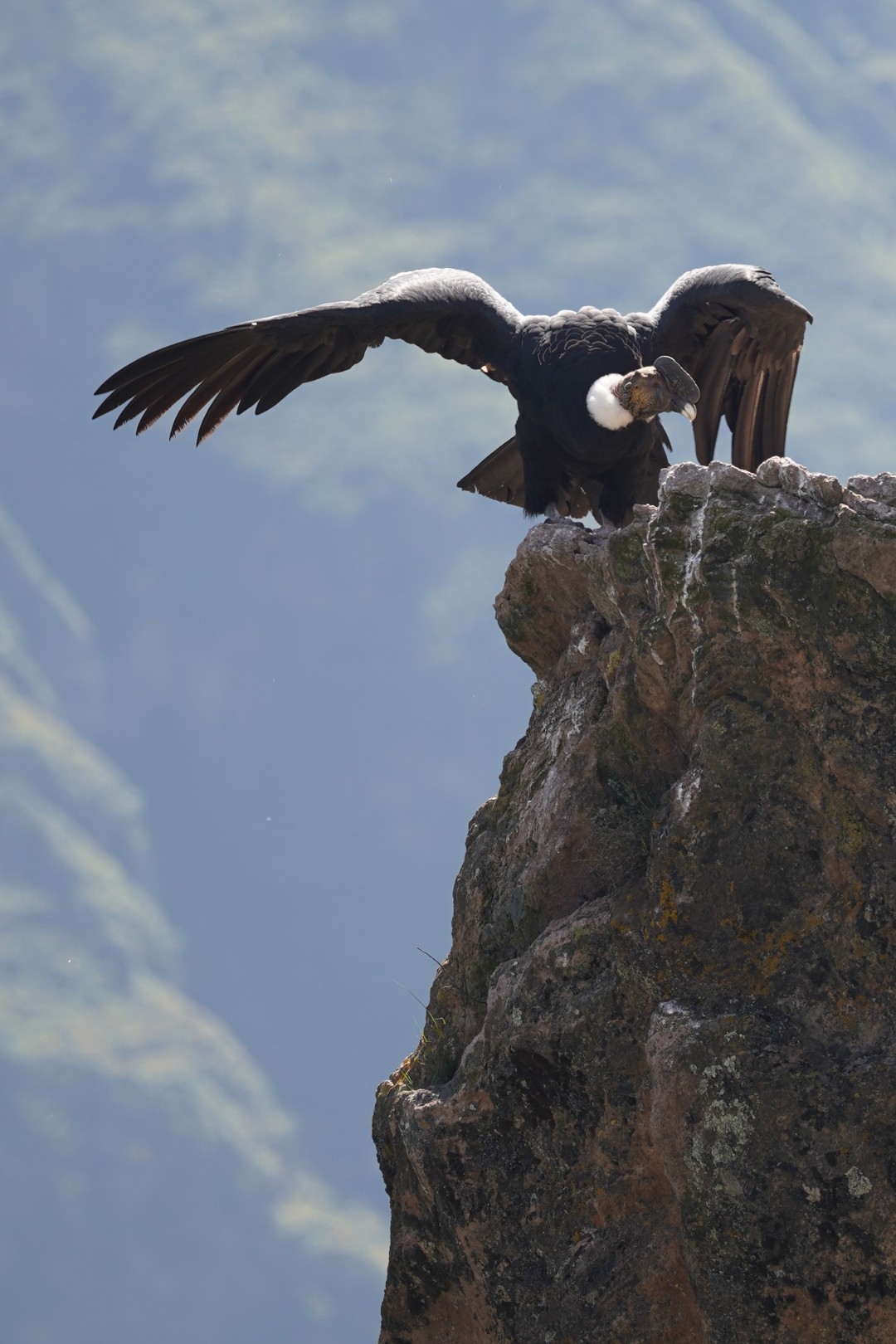
The main attraction of this tour was to visit Colca Canyon to view condors, one of the few reliable places in the world where you can view this giant bird. They are one of the largest flying land birds in the western hemisphere, with wings spanning up to 10.5 feet (3.2m)! It was a good thing Mr. Wander had been getting so much practice at bird photography this year!

We were picked up fairly early in the morning but managed to sneak some breakfast just as it opened at the hotel. The van took us first to a small town where children were performing a traditional dance as they asked for donations.

Finally we made it to the canyon, and we really lucked out not only with the weather, but there were so many condors!


It was a little quiet at first, with most sitting on the wall nearest to us or staying low in the valley. As the temperature increased, the condors left their perches slowly started taking flight higher in the canyon and soon they started to fly directly overhead!


It was so cool to watch them, they seemed to just soar with the wind, likely using different thermals to help loft them higher as the sun warmed the air. They were flying so close by the end that Mr. Wander’s zoom lens was too good to capture some of them. To give you a little perspective, below are ones I took with just my regular camera. The single Condor below is sitting on the same roost as the group of 3 in Mr. Wander’s images above.


After giving us nearly an hour watching these condors, our guide took us on a bit of a hike through the desert and pointing out several foliage. We could still see some condors here and there but most were at the big overlook. We took some photos and I enjoyed the view of this canyon. It is one of the deepest canyons in the world, with some sources saying between 11,100-13,600ft (3400-4160m), that is crazy, and it’s not just rocks either, I was surprised at all the green!


They took us back to Chivay to get lunch, this time at a different spot, and then they headed to Arequipa. We did a quick stop in a small town where we could get souvenirs and try a different type of pisco sour using sancayo cactus fruit and it is known as a colca sour. It was pretty delicious. I also enjoyed the dressed up alpacas and was entertained by the story behind this statue, of a woman carrying her drunk husband home from their wedding!


We stopped once more at the rest area from the day before where we switched vans, but mostly we went directly back to Arequipa, and got checked into our hotel.
Chocolate Adventure
We decided to try a different version of a cooking class in Peru. As a baker, I have wanted to try to temper chocolate on a marble slab ever since I saw it on a baking competition show, and we found this class in Arequipa that would let us do just that.

The class involved so much more though, from learning the history and making our own “drink of the gods”, to learning about international chocolate standards for what constitutes “dark” or “milk” chocolate.

Our guide started with telling us about how chocolate is grown and harvested to get to this bean he had there. He had a whole tub full and our first task was to sort out the good, whole beans with no cracks from the partial ones.

We put them on trays that went into an oven to roast for about an hour. Then he had a pile of extra shells and such that did not make the cut and he put them into a tea pot with hot water. After steeping we all got a small glass of chocolate tea. This was really neat, it had such a subtle flavor of chocolate, but still not overly bitter.

Soon it was time to take the beans out of the oven, boy did they smell delicious! Next we shelled them and placed them into a mortar where we took turns grinding by hand. It was hard work! Once ground by hand our chef took it and mixed it with hot water and this fancy wooden whisk called a molinillo, and we each had a hand at mixing this as well.

He added brown sugar as well as some other spices and then we all got to have a drink. This is what is sometimes referred to as the drink of the gods, because the Mayan king would drink this almost constantly, and it was generally limited to those in power. Although our chef said it was less because of any religious reasons, but instead because it was an aphrodisiac. It was very delicious, I do really enjoy putting cinnamon in my hot chocolate from time to time but I am used to it being much sweeter.

We moved into a different kitchen where we were given molds of 12 little domes to put in whatever flavors we would like to make our own chocolates to take home! They had dried mangoes, strawberries, and golden berries, grains such as quinoa, a few nuts and salt. Mr. Wander and I both did a mix of them to try some fun options, such as quinoa.

Finally it was time for the highlight, getting to temper chocolate! Thankfully we didn’t have to grind up more cocoa beans as we would have been there for days to get it smooth enough for making a chocolate bar! They have electronic means of grinding the beans after they’ve been roasted and he said it still runs for days to ensure it is smooth enough. After mixing in specific quantities of sugar and milk to make the desired cocoa percentage, it is ready to be tempered.

Tempering is a process that is used both in cooking and metal work, as it changes the properties of the final product. In metal, it increases strength while maintaining some ductility through bringing the metal through specific temperatures by cooling and heating, affecting the crystal structure of the molecules. The same is actually true for chocolate, only here you want to create that lovely “snap”, a glossy look, and to make it easy to remove from molds, but the idea of cooling down the chocolate to achieve the specific crystalline structure is the same.


First the chef took the dark chocolate and was explaining the process as he tempered a full bowl, starting with warming it to make sure it is completely melted, above 122F (50C). Then he poured most of the bowl onto the marble counter, painting it out with a spatula and then working it back together and moving it around the table, constantly bringing in the edges. He’d take a short break, just long enough to check the temperature with an infrared thermometer before continuing. Once it cooled to 82-84F (28-29C) he scraped it back into the bowl, where some of the warmer chocolate remained. After stirring it together he checked the temperature again and in some cases, the temperature will be right at the ideal working temperature of 88-90F (31-32C), but this time he did have to heat it up a little more.

He set the dark chocolate aside for now it was our turn! We all learned the spatula scraping method of using one to scrape the bench and another to scrape the chocolate off the first. Then we each got our turn of helping with the milk chocolate. The temperatures are a little different for milk chocolate with the melting temperature at 113F (45C), tempering to 81-82F (27-28C) and rewarming to 84-86F (29-30C), all a few degrees below that of dark chocolate.

After the chocolate was successfully tempered, we used it to fill our trays of prepared flavors, choosing between dark and milk, both Mr Wander and I split ours between both so we could try both flavors. After filling we got to lick our own spoon and then we headed back up while the chocolates set.

Something interesting to consider, as you notice those temperatures for tempering chocolate are just above normal room temperature, so you need the marble slab to be cool enough to be able to cool the chocolate as low as 80F (27C). Peru fairly close to the equator and normally has fairly warm temperatures, however Arequipa is high enough in elevation that it isn’t as hot as the northern jungle where cocoa grows best. Ghana and Cote d’Ivore, which produce over 60% of the worlds chocolate, is very hot and humid, way too hot to temper chocolate. However, when you think of chocolate you think Switzerland, or Germany, where it is considerably colder and more readily could have tempered chocolate before the days of refrigeration. Something I hadn’t truly considered before our chef mentioned it.

Our last task was to try and identify not only whether the chocolate is real or fake, but whether it is milk or dark chocolate, and what percent cocoa was in each one! I got close on a few but the winner in the group got a free pisco sour from the restaurant downstairs. It was fun to test ourselves though, and there was some good humoured making fun at the fake chocolate that some of our countries make that may contain less than 2% of cocoa! If you want a hint at how to determine whether your chocolate is real, just make sure if you get a dark chocolate that cocoa is listed first, and technically you only want milk, sugar and cocoa bar in any chocolate you eat!

After thanking our chef and bagging our chocolates, we headed downstairs to enjoy a pisco sour and order a savory pizza after all that chocolate tasting. It was very delicious!

We walked around the city a bit trying to find Mr. Wander a cell phone repair place but had no luck, so we found a few supplies so he could perform a bit of hardware surgery before our next flight. His battery had been starting to act up and our time in the rainy jungle on our way to Machu Picchu was where it had took a turn for the worse. We worried his phone might get confiscated before the next flight as the battery had swollen so badly so instead he cut out his battery so he didn’t lose any of his data or the phone.
Next Time
With Mr. Wander’s cellphone plane-ready, we flew to Iquitos to board a cruise on the Amazon river. For 4 days we enjoyed delicious food, learned about the animals of the rainforest, met a shaman of a local tribe, learned to make the perfect pisco sour, and went fishing for piranhas. We even got to see some parrots and manatees up close at a rescue center. Until next time, Adios!
Leave a Reply