Have you ever tried to book flights between African countries? There aren’t many that go directly between them with the exception of a few hubs such as South Africa, Kenya, or Ethiopia. The other option is to go through the Middle East or Europe. As we were headed to Morocco next, the best option of us was to use Turkish airlines with a layover in Istanbul. We decided to make this a stopover to explore for a few days, so we didn’t have 12 hours of flying on the same day. After exploring a few sites we headed to Marrakesh, Morocco where we enjoyed delicious spices, sights of the desert, and even a fire show!
Istanbul
We left in the middle of the night to catch a 5am flight to Istanbul, Türkiye. Little did we know the Istanbul airport would keep us for almost 3 hours, between Mr. Wander’s parents getting through customs and all of us not getting our bags! They apparently never loaded the bags in Arusha, so 56 were still waiting at the airport in Tanzania. Finally, I got things filed with the airline to get our bags delivered to our hotel, his parents made it through, and we had to find ourselves new transportation as ours pickup couldn’t wait that long.

After a long walk to get picked up by an Uber (who might have been wanting to avoid airport charges), and some rush hour traffic, we made it to our hotel and were ready to get some dinner. Us kids went out to a nearby rooftop for dinner as we were all pretty hungry, not really getting lunch just a few plane breakfasts. It was delicious food, tasty drinks, and cool views of the city and the Hagia Sofia.


The following morning we had a walking tour where we visited the inside of Hagia Sofia, which you might remember from us visiting last fall. It was interesting learning things with a different guide, but she was very good. If you want to refresh your memory check out the post here: Istanbul 2024.

Next we visited the Byzantine Cistern, which was new for me, but Mr. Wander had visited nearly 20 years ago. It was really cool but quite humid in the cistern. The lights changed every few minutes from more of an orange light to one that was green.


There was an interesting column with the teardrop shape that is somewhat reminiscent of the evil eye you might see around Greece, meant to ward off evil spirits. Another theory was to represent the tears of those who built this cistern, but our guide was learning towards the protection theory.

This is one of the largest cisterns in the city and there are holes in the ceiling where they used to lower buckets to collect water for use. It had one time been filled to the ceiling!


After leaving we did visit a Turkish rug shop, it’s hard to do any sort of tour an NOT visit one but this one felt unique. It was the least pushy of the 3 we have visited in the last few years and their goal was to support country artisans and to keep the handicraft alive. The building was originally a hotel for merchants visiting along the silk road in the 16th century, with places for their camels to be refreshed. We took a card in case we decide to get a rug for our someday house, I would choose this location over others because it is state sponsored and so more of the proceeds go to those actually making the rugs.

Our last stop was to the grand bazaar where I ended up buying a new cashmere scarf. It is very beautiful with a few shades of blue ombre into a grey-tan and is quite soft, which of course had me at first touch (if you know, you know). I am excited to wear it this winter around Europe!

As our guide had to head to another tour, she reserved a table for us for lunch at a nearby restaurant and Mr. Wander and I both ordered some pretty tasty pides that were almost as good as the ones we had in Trabzon last year, but they did tell us it was a specialty in that region.

That evening after both Mr. Wander’s brother and sister-in-law visited the traditional bath house called hammam, we headed to a dumpling place for dinner. It was fun as they had different dumplings from around the world, but also they had Turkish ravioli that I had been craving. It was a little different than others I had had in the past and liked more, but still satisfied the taste I was looking for.

Sometime in the middle of the night our bags were delivered so we all managed to get them before breakfast. We had nothing scheduled for the morning, so Mr. Wander went on a walk with his dad around the city but didn’t make it to the blue mosque as the line was so long! His brother’s family were meeting up with a former coworker for lunch and they managed to get inside.


I started trying to catch up on writing and enjoyed a bit of time to relax by myself. At 4pm we all met in our lobby to get picked up for a small cruise on the Bosphorus Strait. We were in a boat which held about 20 passengers, and they gave out some snacks, water and tea as we ventured up the European side, and back down the Asian side. Along the way we saw many boats joining us on the cruise of various sizes, and some of them were decorated for a wedding! A few of the hotels had plazas overlooking the river and there were more than one woman in a wedding dress taking pictures during the golden hour. We made it back near the old town area just in time for sunset and a call to prayer. After this we were taken back to the dock and then to our hotel.
Marrakesh
The following morning we made it to the airport for our midday flight to Marrakesh. We arrived mid afternoon and thankfully this time with our bags. Our accommodation was a traditional Riad and was located in the old town part of Marrakesh, called Medina, which is full of winding streets much to small for cars, so they can only drive in a few areas. This meant we had to walk with our bags about 5-10 minutes, dodging many motorbikes winding through the pedestrians.


We ordered our dinner from the Riad for that evening and all relaxed a bit until then. For dinner I had to try a tajine (also spelled tagine), which is a traditional dish with meat or veggies cooked in a two part clay pot. The best part about these are the delicious spices, all fresh and fragrant. It’s not spicy like with peppers, but full of cinnamon, and ginger, and other tasty flavors.

Mr. Wander tried a bastille, which is were often chicken is cooked in a pastry along with almonds, heavily flavored with cinnamon. It was very tasty, but almost a sweet dish as powdered sugar was used as a design on the top and with the almonds inside.


We had a few mocktails and enjoyed our cup of mint tea with our dessert, most of us getting assorted small pastries but my favorite was my sister in law got oranges with cinnamon and wow was that delicious! The pastries were good but got a little too sweet after 2 or 3 and they served us 5.
Walking Among the Souks in Medina
The following day we booked a walking tour around the old town area. We started at the Jal square, which was just a few minutes walk from our Riad. This square was named for the executions of prisoners that used to happen. Now it is used for exhibitions by day and the night market each evening. The square becomes full of stalls of street food and even locals come to have their dinner.

Marrakesh is the 2nd oldest city, built between the 11th and 12th centuries. Arabic and French are the two main languages spoken, however there is a local dialect that is a mix between French, Spanish, Arabic, and I think others called Darija. Most of the citizens practice Islam, so you will often hear the calls to prayer at dawn, midday, mid-afternoon when the sun is at 60 degrees to the horizon, at sunset, and at nightfall. Jewish and Catholic are the other two most practiced religions and make up about 5% and 2% of the population, respectively.

The native people of Morocco are Berber, of three tribes between North, South and Atlas Mountains. In the 7th century, Arabs came here in peace and helped them fight off the Romans trying to take over. From them they learned about Islam. Today, in school kids are taught Arabic and Berber when they first start, however Berber was originally just a spoken language and only recently has been transcribed. Later in school they learn English and French especially when starting certain subjects like science or math.

Our guide taught us many things about the city, history and culture as we wandered the streets. Most of the shops were not open yet as we started at 9am and the city tends to stay up late, he even claimed it to be a city that doesn’t sleep. One interesting fact was that before, women would not leave the house except to change houses when they were married and to the cemetery when they died. The first school for women was built in 1960 and now schools are mixed and parliament requires at least 30% female! It has come quite far quite fast.

We wandered through an area famous for the wood art, where they use lighter wood like lemon and darker like Lebanon to create patterns in various bowls. They also used mother of pearl or camel bone for accents. Another narrow street was full of yarns and threads of wool or silk that have been dyed by natural pigments such as saffron, It is known as the Souk des Teinturiers, as Souk refers to a market place.

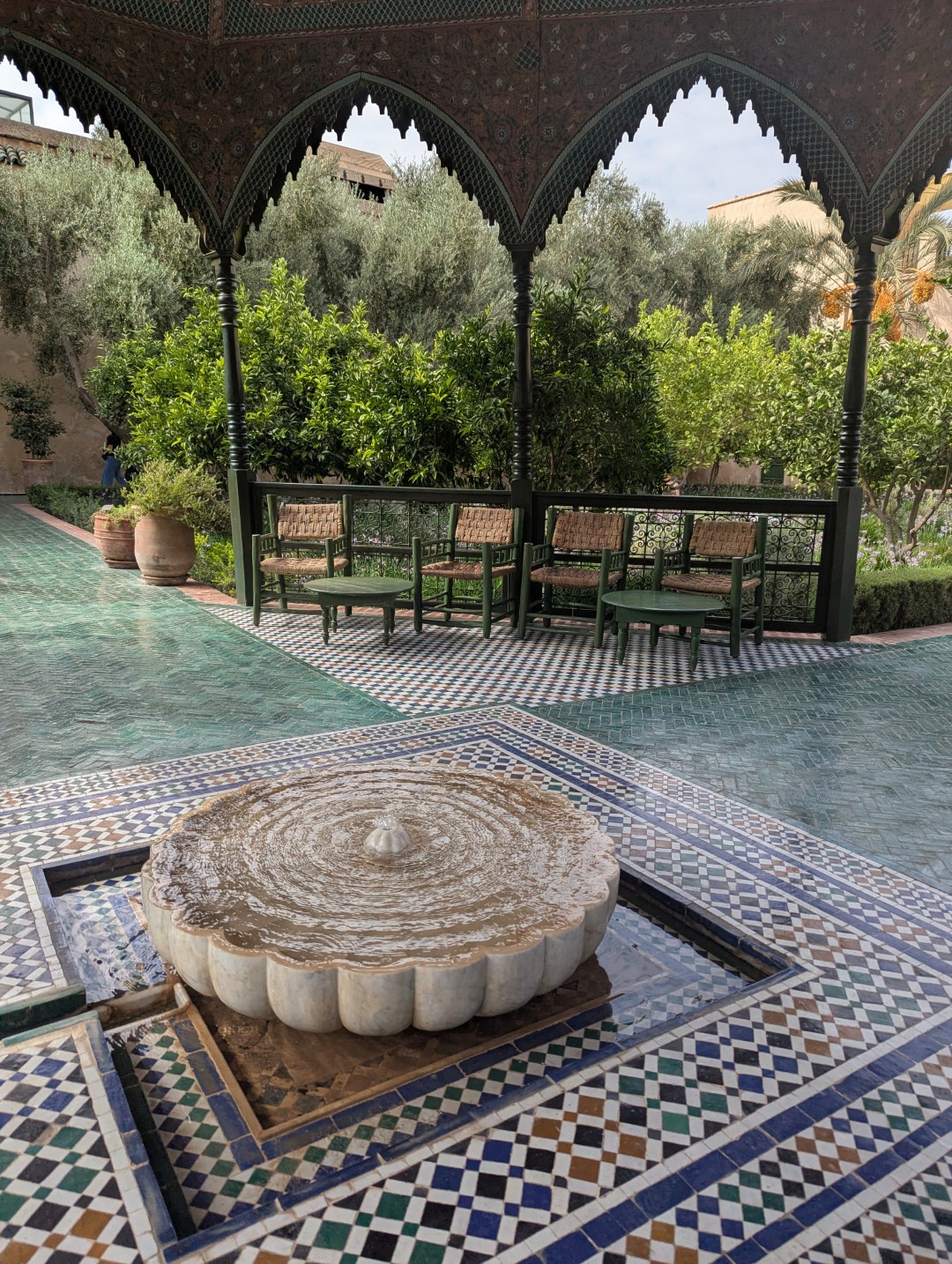
We arrived to the Le Jardin Secret, which was built according to Islamic garden principles. It started as a Riad for an important family, as this was the administrative area of Marrakesh. A riad is a family home with a courtyard or fountain in the middle. There is a royal room for the chief family, and two living rooms facing East and facing West. One is used in the winter, and the other in the summer. Since this was such a large area, there were other dars for the various family members with connections between.

The irrigation for the plants is provided by a fountain that comes from the Atlas mountains, which are about 35 km away. Holes were built in the 11th century and the water is naturally filtered using sand and stone. All fountains in the city received their water the same way.


The garden contained plants bearing most of the fruits from the Quran, including dates, grapes, figs, olives, pomegranates, and bananas. One of my favorite parts was this carving that is of Moorish design, as it is a mixture of Arabic, Jewish, and Berber. Perfect blend of cultures.

One interesting spot we stopped at was a bakery where someone was tending to the fires. Often families would make the bread in their home, and then bring them to the bakery where they were cooked in the wood fired ovens. These ovens also heated the water in the traditional hammam baths.

Each neighborhood had a fountain provided from the Atlas mountains, a hammam, and a bakery. I really appreciate the efficiency in a place where you wouldn’t want to heat up your own home by baking long periods of time each day, but also utilizing excess heat for other benefits. These fountains used to be free but now with modern plumbing to get water in your home you need to pay the city for the utility.


The rest of the tour we hopped between different specialty shops for leather shoes (made from goat, camel and sheep), spices and oils for natural medicine or tasty teas (like argon oil or saffron), and of course, a rug hop. This one did let us try to learn to do the knot ourselves which was interesting to attempt! The women spoke no English but with my limited french and her demonstration I did okay.

As various family members were in need of a break they split off from the tour so at the end it was just my father in law and myself that made our way back to the square where some of the snake charmers were starting to appear. I tried to sneakily take a photo but it’s not too good. We headed back to the Riad and I went up on the rooftop to relax and try to capture some of my notes.
Aït Benhaddou
After a day of relaxing, we booked a tour that took us a few hours outside Marrakesh into the Atlas mountains to the ancient town of Ben Haddou. Along the way we stopped for a delicious breakfast with a view!

Then we stopped at an Argon Oil factory to learn about the process and try out products. Argan Trees only grow in South East Morocco, and are often called goat trees since they like to climb in them to eat the shell while spitting out the nuts.


These nuts are then harvested, and processed to either become edible or used for cosmetics. It is roasted and heated in water until the oil rises to the top to use on a salad or as a butter mixed with honey. Otherwise it is ground by hand and the oil that comes out is put into moisturizers, lip balm, soaps, and hair products. In Mr. Wander’ first trip there over 10 years ago he got me a bottle of Argan oil, which I did actually really like on my hair, especially in the dry winters of Minnesota.

Finally we arrived to the village of Benhaddou. It was built in the 11th century and has been a UNESCO world heritage site since 1987. Approximately 70 families started the village and there are 5 still living here.

If you have watched any of the movies or shows in the picture above, you likely have seen Benhaddou. One of the more famous is the movie Gladiator, it took 6 months for them to build the stadium just outside the city and yet they only filmed there for 3 days, and then they had to take it back down again.


Nearby a man was painting a picture using green tea, saffron and indigo, some of which is mixed with sugar. They used to do this on goat skin that allowed it to be re-used but now they just use paper. When we walked over to get a closer look, he put the painting over a flame and the parts that were mixed with sugar started to caramelize and it smelled like creme brulee! The painting came alive with contrast, as you can see the before and after.


Due to the UNESCO status, the external parts of the homes cannot be changed and must be repaired with the same materials, mud and straw. While they still use candles, they also have solar panels and internally the houses are quite modern, even with a TV!

We climbed right up to the top where the watchtower is undergoing restoration after the 2023 earthquake caused it to collapse. We had one detour on our way up due to a landslide caused by this same earthquake.


The family made their way back down the village into a town where we had some lunch. Then it was time to get back in the car and head to Marrakesh. We stopped to see some dwelling cut into the rock, and at a viewpoint for the mountains. The Atlas mountains were named such thanks to the Greeks that had visited 1000 years ago and were so amazed by them, they thought that their god Atlas lived there!
Afagay Desert
On our last night in Morocco, we joined a group to visit the Afagay desert for a dinner, fire show, and for some, a sunset ride on a camel. Of course on the way we had to stop to visit another argan oil shop but at least there were bathrooms and tasty mint tea available.

The next spot was to a cool viewpoint to watch the sun go down while Mr. Wander’s Brother and his family participated in the ride. Our nephew even got to ride by himself!

It wasn’t actually a camel they were on, as camels have 2 humps, and they rode on a dromedary, which has one hump (or less). They are both a part of the same camelid family, which actually originated in North America but had migrated across the Bering Strait around 6 million years ago. If you remember our time in South America learning about the alpacas, llamas, vacuñas, and guanacos; which are actually a part of the camelid family as well!

We were taken to our final spot which was where we were served dinner with a few tajines, rice, a tomato based soup, and some much needed water. There was a bit of a dance party while some people were finishing their meals, and it was pretty cool to watch people of different cultures and from different countries enjoying the music together.


When the music stopped we were sent down to an area to watch someone performing some fun tricks with various fire implements, including breathing fire, and especially this large ball on a rope that flung fire as he spun it. I was having fun with night mode to capture some fun long exposure shots.


Before we headed back to the van I decided to visit the restroom, but it was the weirdest toilet I had ever seen. Between Southeast Asia, Nepal and even Turkey, I was fairly used to a squat toilet, which is usually a longer trough with ridges on the sides for your feet to help with traction. However, this one was where they took a normal toilet bowl, but removed the pedestal and sunk it partially into the ground. The seat was about 4-5 inches off the floor, which was way more complicated for women since, well, the target wasn’t shaped for how I needed it to be! It took a bit of thinking and no small amounts of mobility to sit on the seat and get my legs in the right spots for it to work. Probably more information than you all needed but sometimes these are the adventures you get when you travel around the world!

After an hour of driving we were back to our Riad and I was happy to return to a normal bathroom. Our week in Marrakesh had been lovely, full of tajines, my favorite was this one we had overlooking the main square with beef, onions and tomatoes that had been caramelized by the slow cooking method. Mr. Wander tried several version of the bastille that varied in the sweetness and earthy notes by the amount of spices used. We had taken a few days off in between the tours to give time for relaxing or exploring on our own, but it also allowed the few of us that ended up with some food issues from either Tanzania or Morocco (or both combined…) to stay rested and hydrated.
Next Time
After saying farewell to the family in the airport of Marrakesh, we boarded our flight to Manchester in the UK. We spent about 10 days between Manchester and London catching up with travel friends, tasting some delicious cocktails, and getting everything setup for our next African adventure! Until next time, Beslama!
Leave a Reply